
How to use JUMP Instruction in PLC Ladder Logic?

 Jump instruction in ladder logic is used to skip some process or rungs according to the requirement. It is paired with Label which is used to limit the skipping the process.

Let’s study the working of jump instruction using an example.

Example – JUMP Instruction in PLC Ladder Logic
There are seven motors used for various processes. On-demand base Motors 4, 5 & 6 are needed.

Design a program to skip motor 4, 5 & 6 when it does require for the process.

PLC Program
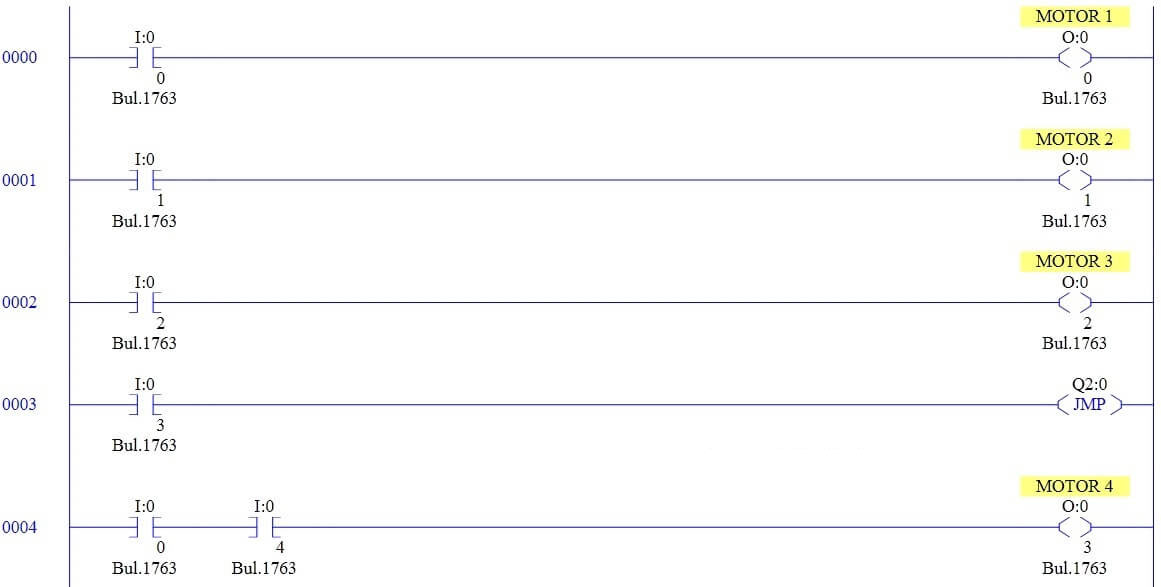
Program Description
RUNG 0000
The input I:0/0 is used to turn on  Motor 1.

RUNG 0001
The input I:0/1 is used to turn on  Motor 2.

RUNG 0002
The input I:0/2 is used to turn on  Motor 3.

 RUNG 0003
The input I:0/3 is used to initiate the jump function (Q2:0).

RUNG 0004
The input I:0/0 & I:0/4  is used to turn on  Motor 4.

 RUNG 0005
The input I:0/1 and I:0/5 is used to turn on  Motor 5.

Rung 0007
Label instruction is used to finish the jump function.

The input I:0/6 and I:0/2  is used to turn on  Motor 6.

When JUMP condition is OFF :


When Jump condition is not initiated or enabled, all outputs will turn ON/OFF according to respective input.

When JUMP condition is ON :
Rung 4, 5 & 6 are completely skipped till label function.

Jumping Backward
If we use label instruction first and then jump will perform jumping backward function.
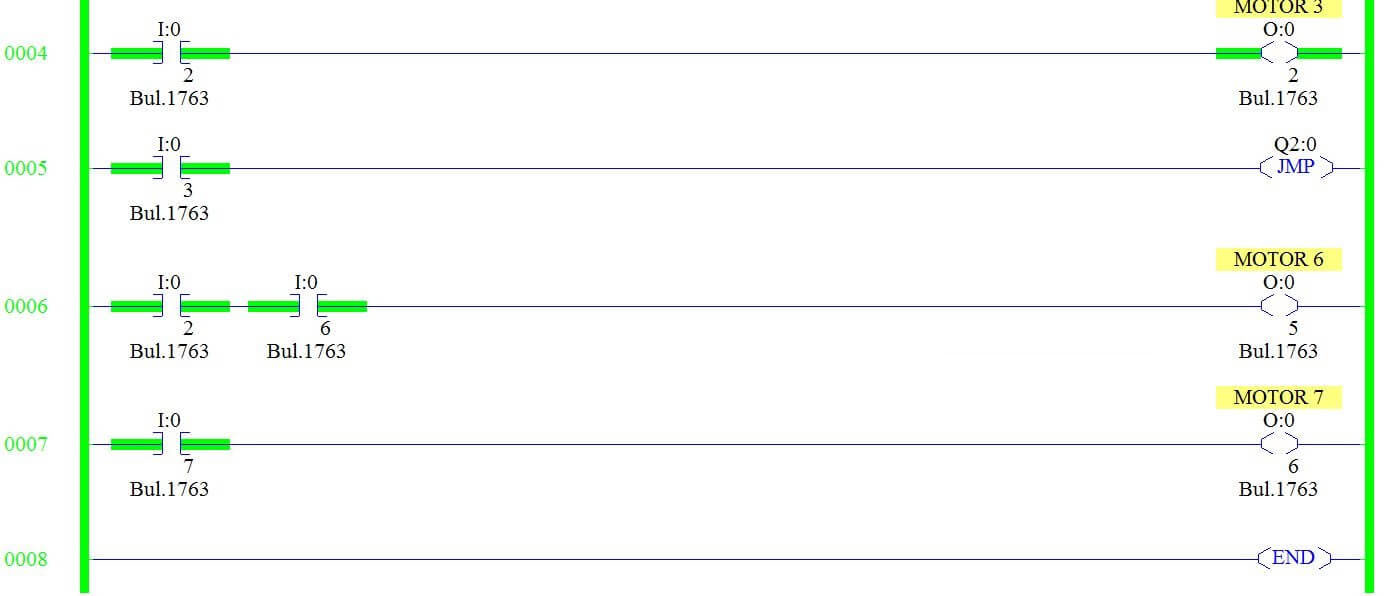


Jump instruction resumes program execution before the label and after the jump instruction. In between rungs will work on respective inputs. 

Conclusion:
The above-explained jump instruction is for example only. It may vary from real-time applications.

-END-

Comments

Popular posts from this blog

Ferrules and Cross Ferruling

 Ferrules are identification labels provided for every wire terminations in an instrument, equipment, or electrical/instrumentation control panels. These tube-shaped sleeves can be inserted easily on each individual wire in a multi-core cable. In earlier days fixed digits/letters are used as ferrules, but now Instrumentation engineers/technicians prints out desired ferrules by using a ferrule printing machine. Typical Ferrule The numbers/ letters on the ferrules will be given as per the approved electrical hook up or loop diagrams. This helps technicians to easily identify a particular loop/wiring from a series of terminal blocks and to troubleshoot the desired terminal connection. Separate numbers on the ferrules distinguish the positive and negative polarities of wires, thus ensure the polarity protection of the instrument. Cross Ferruling  As a wire is connected on its both ends, it is quite useful to use a cross reference method for wire identification. Unlike normal ferru...

What is a Torbar? – Averaging Pitot Tubes

 The Torbar is employed for flow measurement of liquids, gases, or steam in circular, square, or rectangular section ducts for large flow rates. The Torbar is an insertion type multi-port self-averaging primary sensor for flow measurement. Torbar TORBAR is a set of Pitot tubes mounted on a bar across the pipeline with no moving parts. An averaging Pitot tube is a technology, while TORBAR is a manufacturing brand name. There are several brands available in the market with VERABAR, ANNUBAR, etc. Averaging Pitot Tube Principle Purpose Averaging Pitot tube can be employed when the average velocity of the flow profile, rather than the velocity in a specific point in the cross-section is desired. Averaging Pitot Tubes Principle It measures the differential pressure between the static pressure tap and the tap of full pressure of a stream. Thus such magnitude of differential pressure is directly proportional to the square of the flow rate. Working The TORBAR is designed in such a way that ...

The Method and Process of Siemens PLC Hardware Configuration

 The hardware configuration of Siemens PLC can usually adopt the following methods and processes: Determine control tasks and system requirements: Before hardware configuration, it is necessary to clarify the tasks and requirements of the control system, including the requirements for input and output points, control accuracy, speed, and safety. Select the PLC model and module: According to the control task and requirements, select the appropriate PLC model and module, including CPU, I/O module, communication module, power supply module, etc. Assemble the cabinet and install the modules: According to the selected PLC model and module, assemble the cabinet and install the modules, pay attention to the installation sequence, cable wiring, wiring method, etc. Connect the input and output devices: connect the input and output devices with the input and output modules of the PLC, you need to pay attention to the correctness, stability and safety of the wiring. Perform software configura...